
Five Things I Love (and Five Things That Test My Patience) About In-House Casting
If you've ever wondered how a wax model becomes solid silver, the answer is casting. It's one of my favourite jewellery-making processes—but also one of the most frustrating. Like most parts of jewellery making, it has moments that are incredibly satisfying and others that test my patience.
Casting is a process where molten metal is poured into a cavity space. A casting tree is created using wax or using specilised resin via a 3D printer, this casting tree is submerged in a liquid with a similar process to plaster of paris. The casting tree is then burned away over a number of hours, then the molten melted is poured into this mould.
At Lynne Lee Jewellery, we do casting inhouse with the Neutec J-2R system. Here are the things we love and the things that test our patience with casting;
Positive 1: More creative options

The casting method allows for creative options that would either be very difficult or i
mpossible to achieve via other methods. Jewellery that is sculpted in shape could only be done via casting or milling.
With casting, i could make jewellery via wax carving or via CAD design.
Positive 2: Reusing scrap metal
Scrap metal is an expected by product of making jewellery, from cut offs, left over bits of metal and even the metal dust created. This metal scrap can be collected and is often sold to refinerys. Casting inhouse allows for this scrap metal to be recycled inhouse and goes into the next piece of jewellery made.
Positive 3: Faster turn around time
There are services that can do the casting process for jewellers. However, this process can be slow, the wax or resin mould needs posting to the casting house, then it is a wait for the casting house to cast the item and post back to you. By casting inhouse, it can reduce the timing of 1 or 2 weeks via a casting house to as low as 1 day inhouse casting.
Positive 4: Faster creation

Casting is a faster and easier production method and more suited for certain outcomes. For example casting a cuban chain, is infinitely fast than if i want to try hand fabricate every chain link.
Positive 5: The magic of creation
There is something wonderful about seeing the silver melt into a liquid, press the lever to release the liquid into the mould. Then shortly after see the Silver hard formed into the previous wax shapes.
Even after doing it many times, watching solid silver emerge from a mould that only hours before contained wax never really loses its appeal.
Negative 1: The mess / health risk

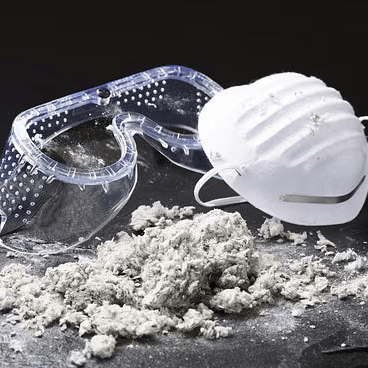
Investment powder contains respirable silica, so it's one of the stages where proper safety precautions are essential. Exposure to this dust without protection is extremely dangerous and can cause signficant health conditions. Good extraction, appropriate respiratory protection and careful working practices are all part of casting safely.
Negative 2: Porosity / failed castings
Castings can fail for many reasons. A common problem is called porosity, which is like the metal surface bubbling, which can look unsightly and affect the structual integrity of casting. Porosity can happen for a number of reasons. A bad casting result can mean the whole process needs to start again and investigation into possible caused for the porosity.
Negative 3: Post casting clean up
After a wax tree is cast, there is a high amount of clean up work; sawing off the individual pieces, removing any firescale from the cast pieces, sanding off any rouch edges created due to the casting process. It is an extra step of work compared to non casting processes.
Negative 4: Having a furnace running for hours

One stage of the casting process is called burn out. This is where the wax tree is burned away from the mould, this process can take between 5 to 12 hours. This means there is a furnace actively running at temperatures around 500c to 800c for those hours.
This can be a stress to have an active furnace running for so long without being actively monitored constantly.
Negative 5: The Long Wait
An early stage in the casting process is pouring the investment mix into the flask. Once the flask has been filled, you cannot see the wax tree, you don't know if the tree has broken or has any other difficulties. So for around a full day you have to continue the stages of casting without any indication if the cast will be successful until the very end of the process. It can be an anxious wait.
Despite the failed castings, the clean-up and the long burn-out cycles, I wouldn't give it up. Casting gives me the creative freedom to make jewellery that simply wouldn't be possible through fabrication alone—and for me, that's worth every challenge along the way.

Leave a comment
This site is protected by hCaptcha and the hCaptcha Privacy Policy and Terms of Service apply.